




Gnanamani College of Technology

News

Gnanamani Educational Institutions proudly hosted the Alumni Meet 2025

Admission Apply Now

Electronics and Communication Engineering

Overview

The Research & Development (R & D) Cell of ECE Department facilitates and encourages research culture among the faculty members, research scholars and students. Its prime role is to create contacts with the real world and promote research through a range of publications. It enables a pleasant environment for technological development and monitors the research activities of the college.

The Research & Development (R & D) Cell of ECE Departmentencourages the development of novel ideas, filing of patents and the establishment of collaborations with industry partners, thereby contributing to the commercialization of research outcomes. Moreover, it plays a crucial role in enhancing the institution’s research culture, ensuring submission with ethical standards and aligning research activities with national and international priorities.


Admission to Ph.D. programs with the recognized Research Centres at all affiliated colleges are made by Centre for Research, Anna University, Chennai twice a year. Aspiring research scholars are expected to get in touch with the recognized supervisors associated with the research centres to fix a tentative research topic and obtain their consent for being a supervisor to the applicant. The applicants desirous of taking up Ph.D. programs with any of the Gnanamani College of Technology Centres of research recognized by Anna University are requested to contact the recognized supervisors at the above centres. The details regarding the entrance tests for Ph.D. admission and other rules are available at https://cfr.annauniv.edu/research/

About the Program
Electronics and Communication Engineering

Duration

Typically 3 to 6 years, with coursework usually required in the first year.

Electronics and Communication Engineering

Modes

Full-time (research scholars) and Part-time (usually for working professionals, requiring a No Objection Certificate - NOC).

Electronics and Communication Engineering

Focus

In-depth research, publication in reputed journals and dissertation submission.

Electronics and Communication Engineering

Types of Admission

Monsoon (July) and winter (Dec/Jan) semesters are common across Anna University affiliated colleges and nearby NITs.

Eligibility
Mechanical Engineering

Educational Qualification

Master's degree (M.E./M.Tech/MCA/M.Sc in CSE or related fields) with a minimum of 55% marks or 6.5 CGPA (50% or 6.0 CGPA for SC/ST candidates).

Entrance Exams

Valid scores in GATE, CSIR/UGC-NET, or University Entrance Tests are required.

Mechanical Engineering

Part-time

Requires an NOC from the employer.

Syllabus (Coursework)

The coursework usually focuses on building a strong research foundation. Common topics include:

VLSI Design

Communication and Networking

Electronics and Communication Engineering

Artificial Intelligence, Machine Learning and Deep Learning Techniques

Electronics and Communication Engineering

IoT Systems

Faculty for Guideship

The details of recognized supervisors are mentioned below

S.No Name of the Supervisor Designation Department
1 Dr. M. Madheswaran Professor ECE
2 Dr. Jennifer S Raj Professor ECE
3 Dr. Kathirvel.R Professor ECE
4 Dr. Prabhu.R Associate Professor ECE
5 Dr. Selvapandian.A Associate Professor ECE
6 Dr. Sathish Kumar.E Associate Professor ECE
Research Areas

The primary research areas focused on are:

VLSI Design

Physical Design & EDA Tools, Low-Power VLSI Design, Emerging Transistor Technologies and System-on-Chip (SoC) & Network-on-Chip (NoC)

Communication and Networking

Next-Generation Wireless Networks (5G/6G), Internet of Things (IoT) and Sensor Networks and Network Security and Privacy

Electronics and Communication Engineering

IoT Systems

Edge and Fog Computing, Security and Privacy, Communication Protocols and Connectivity

Funding/Projects

Internal Funding: Internal research grants are available for students and faculty, particularly for projects at the Master’s and PhD level.

External Funding: Consultancy projects, such as those with Southern Railway (Salem Division), are undertaken to develop mobile applications and web portals.

Fellowships: One-time incentives (e.g., up to Rs. 3.00 Lakhs) are provided upon successful completion of PhD under specific schemes like Visvesvaraya.

Facilities/Research Infrastructure

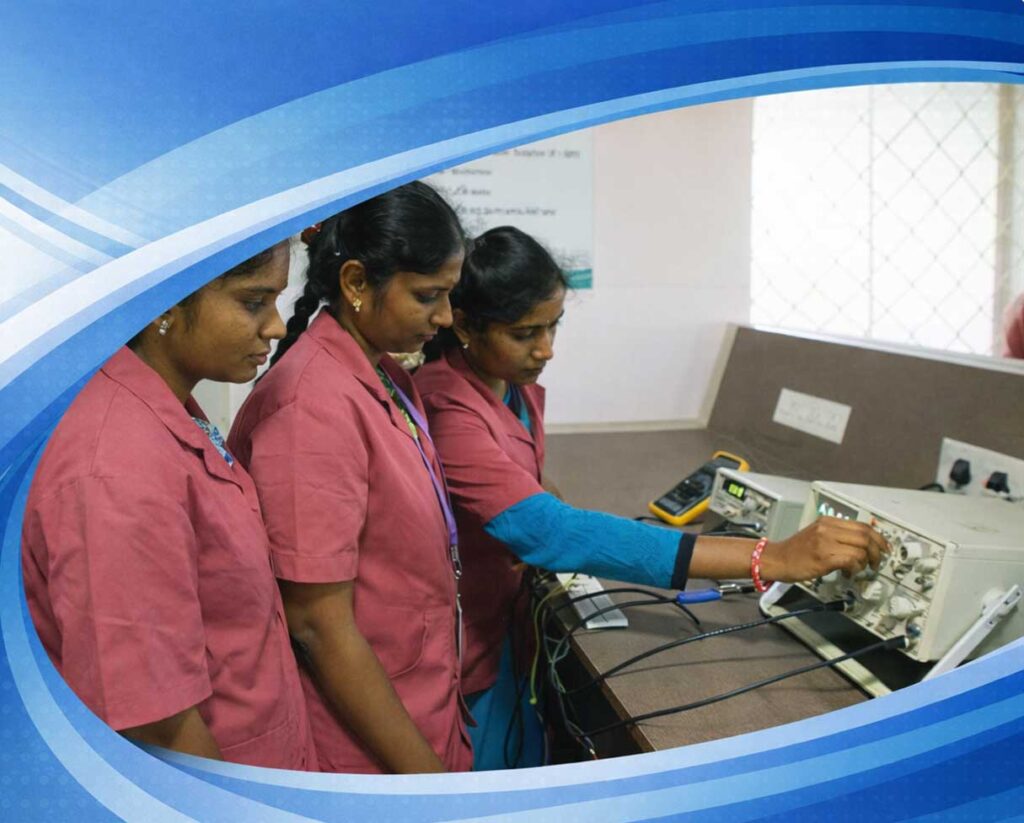
Institutions in Salem maintain specialized labs to support research:

Electronics and Communication Engineering

Computing Power

High-performance computing labs with modern machines.

Electronics and Communication Engineering

Specialized Labs

VLSI, IoT labs.

Electronics and Communication Engineering

Support Services

Digital library, access to e-journals (IEEE, Springer, ScienceDirect), and software simulation tools