



Biotechnology
Introduction
The Department of Biotechnology was established in the year 2020 with a commitment to deliver a broad spectrum of graduates through Programme of B. Tech Biotechnology. The department boasts specialized faculty in Microbial Technology, Genetic Engineering, Biochemistry, Molecular Biology, Bioinformatics, Immunology, Bioprocess Engineering, Plant and Animal biotechnology, etc.
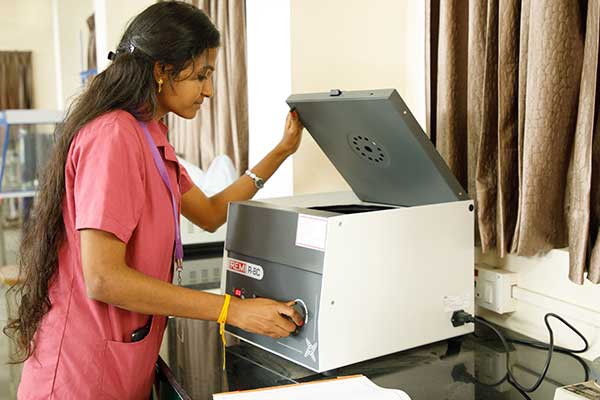
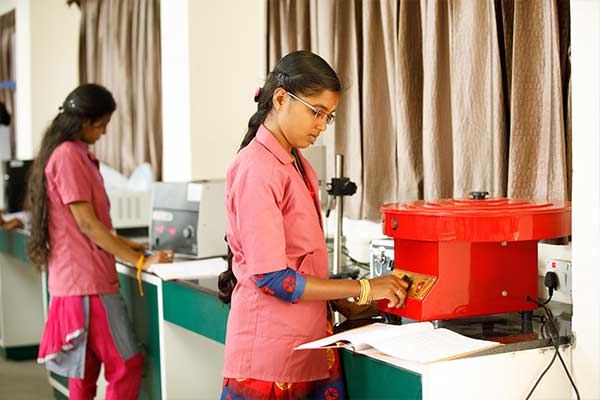
Department has state-of-the-art laboratories to teach and conduct research in multifarious areas of Microbial Biotechnology, Bioinformatics, Bioprocess and Tissue culture technology. We have organized many seminars,staff/faculty/entrepreneur development programs and workshops to provoke student’s interest in various fields of Biotechnology. By providing quality training initiatives, the students are getting placed in their core companies like Syngene International and Zifo R&D Solutions. In essence, the Department of Biotechnology at Gnanamani College of Technology is dedicated to continuous growth and excellence across academic, placement, co-curricular, extracurricular activities, projects, and consultancy services.

Profile
Biotechnology
- Biotechnology is a rapidly advancing field with vast potential and a broad range of applications. Its scope spans across various industries, and its impact is felt in multiple sectors of society, health, agriculture, and the environment.
- Healthcare - Personalized treatments -diagnostic tools - Regenerative medicine.– Improving Agriculture Biotechnology- crop yields - pest resistance -livestock productivity - eco-friendly Bio pesticides - Bio fertilizers.
- Environmental Biotechnology – bioremediation - waste treatment - bioenergy solutions. Food and beverage industry – fermentation - food safety - quality enhancement.
- Industrial biotechnology – Materials - enzymes.
- Bioinformatics and Computational Biology - Analyze genomic data - new discoveries.
2020
Established
B. Tech. Biotechnology
4 Years
Undergraduate (UG)
Scope of the Department
- Biotechnology is a rapidly advancing field with vast potential and a broad range of applications. Its scope spans across various industries, and its impact is felt in multiple sectors of society, health, agriculture, and the environment.
Vision & Mission
Vision
To emerge as a Biotechnology knowledge hub by imparting quality education, research and innovation to address the global challenges with ethical values.
Mission
- To provide holistic education through curriculum updates, innovative and experiential learning.
- To enhance research and development in the area of biotechnology and other allied areas.
- To mould the student as a responsible Biotechnologists to compete with social as well as global challenges.
Program Outcomes & Objectives
After completion of the course, the B. Tech Biotechnology graduates will be able to
- Engineering knowledge: Apply the knowledge of mathematics, science, engineering fundamentals and an engineering specialization to the solution of complex engineering problems
- Problem analysis:
Identify, formulate, review research literature, and analyze complex engineering problems reaching substantiated conclusions using first principles of mathematics, natural sciences and engineering sciences.
- Design/development of solutions:
Design solutions for complex engineering problems and design system components or processes that meet the specified needs with appropriate consideration for public health and safety, and the cultural, societal and environmental considerations.
- Conduct investigations of complex problems: Use research-based knowledge and research methods including design of experiments, analysis and interpretation of data and synthesis of the information to provide valid conclusions.
- Modern tool usage: Create, select, and apply appropriate techniques, resources, and modern engineering and IT tools including prediction and modeling to complex engineering activities with an understanding of the limitations
- The engineer and society: Apply reasoning informed by contextual knowledge to assess societal, health, safety, legal and cultural issues and the consequent responsibilities relevant to professional engineering practice.
- Environment and sustainability:
Understand the impact of professional engineering solutions in societal and environmental contexts, and demonstrate the knowledge of, and need for sustainable development.
- Ethics: Apply ethical principles and commit to professional ethics and responsibilities and norms of the engineering practice.
- Individual and team work: Function effectively as an individual, and as a member or leader in diverse teams, and in multidisciplinary settings.
- Communication: Communicate effectively on complex engineering activities with the engineering community and with society at large, such as, being able to comprehend and write effective reports and design documentation, make effective presentations, and give and receive clear instructions.
- Project management and finance: Demonstrate knowledge and understanding of the engineering and management principles and apply these to one’s own work, as a member and leader in a team, to manage projects and in multidisciplinary environments.
- Life-long learning: Recognize the need for and have the preparation and ability to engage in independent and life-long learning in the broadest context of technological change.
Graduates of Biotechnology shall
- Core competence in Engineering fundamentals and solve Biotechnology related problems.
- Demonstrate excellence in communication, leadership qualities and practice as successful professional in industry and academia.
- Continue to advance in career through long-life learning with ethical value.
Programme Specific Outcomes:
The students of Biotechnology will
- PSO1: Understand, analyze and develop suitable biotechnology infrastructure in diverse domain through acquired knowledge and skills.
- PSO – 2: Design and develop novel bioproducts by utilizing the necessary tool and methods.
Laboratory Facility
The department has full-fledged laboratories that include:
Cell and Microbiology Laboratory
Biochemistry & Bioorganic chemistry
Molecular Biology and Genetic Engineering Lab
Chemical Engineering Laboratory
Bioprocess Lab & Downstream processing lab
R&D Lab
| S. No. | Name of the Faculty | Qualification | Designation |
|---|---|---|---|
| Loading... | |||
| S. No. | Category | Members |
|---|---|---|
| 1 |
Chairperson (1Member) Head of the Department concerned |
Dr.V. Baskaran Dean -Chemical Sciences |
| 2 |
All Faculties Faculty members of the Department |
Faculty members of the Departments of Biotechnology, Chemical Engineering, Food Technology and Pharmaceutical Technology |
| 3 | Subject Experts |
Dr. A. Arunagiri Associate Professor, Chemical Engineering, National Institute of Technology, 94438 08533 aagiri@nitt.edu |
|
Dr. N Samsudeen Associate Professor, Chemical Engineering, National Institute of Technology, Trichy - 620015 98941 82441 samsudeen@nitt.edu |
||
| 4 | University Nominee |
Dr. P Selvamani Professor, Department of Pharmaceutical Technology, Bharathidasan Institute of Technology Campus, Anna University, Tiruchirapalli - 620024 98424 78785 selvamani@aubit.edu.in profselvamani@gmail.com |
| 5 | Representative from industry/corporate sector/allied areas | Mr. R Shurya Chief Manager Sree Amogha Food Gallery Pvt Limited Namakkal - 637407 79041 83832 rshurya@gmail.com |
| 6 | College Alumni | Mr. R Nishanth Plant Operator Sree Amogha Food Gallery Pvt Limited Namakkal - 637407 96292 17365 nishanth10072002@gmail.com |
| 7 | Experts | Dr. Sivakumar C Managing Director Ensafe Technologies(P)Ltd., Salem - 636004. infoensafetech@gmail.com |
| Dr. Renganathan S Director Department of Biotechnology, Anna University, Chennai-600025 99416 13532 srenganathan@annauniv.edu |
| S. No. | Institution | Month & Year | Duration |
|---|---|---|---|
| Loading... | |||
| S. No. | Project Team | Register No | Student Name | Project Title | Mentor Name |
|---|---|---|---|---|---|
| Loading... | |||||
| S. No. | Name of the Student | Company Name | Start Date | End Date |
|---|---|---|---|---|
| Loading... | ||||
| S. No. | Academic Year | Students Participation Count | Prize Winners |
|---|---|---|---|
| Loading... | |||
| S. No. | Academic Year | Faculty Name | Awards |
|---|---|---|---|
| Loading... | |||
| S. No. | Date | Coordinator | Event | Guest Name | Company |
|---|---|---|---|---|---|
| Loading... | |||||
| S. No. | Name of Author | Title of Paper | Name of Journal with ISSN No. | Web of Science / Scopus | Vol., Issue, Page No. | Published Month & Year |
|---|---|---|---|---|---|---|
| Loading... |
| S. No. | Academic Year | Inventor(s) | Title | Application No. | Status |
|---|---|---|---|---|---|
| Loading... | |||||